Featured in This Guide
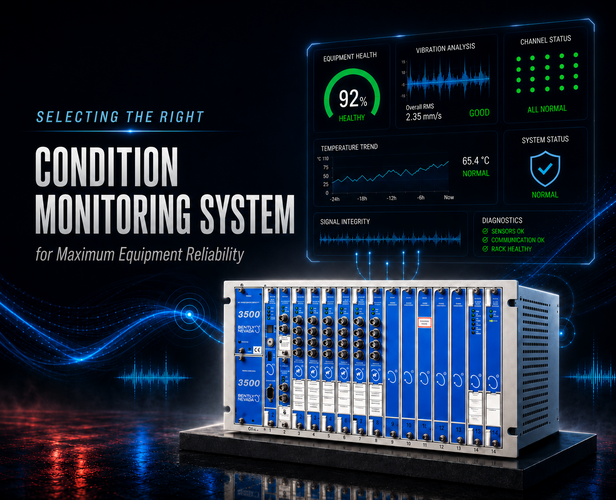
Bently Nevada 3500 Series Complete Rack
Condition: NEW | Stock: Available
API 670 Compliant | 14 Monitor Slots | USA Origin | Weight: 21.72 kg
Shop the Bently Nevada 3500 Now30-Day Warranty • Free Shipping • API 670 Compliant

Unplanned downtime in industrial rotating machinery costs the global process industry an estimated $20 billion annually. A single turbine failure at a power generation plant can exceed $1 million in lost production, repair costs, and contractual penalties. A pump seizure at an offshore oil platform can halt production for days. A compressor breakdown at a petrochemical facility can create dangerous process safety events. These are the realities that make machinery condition monitoring systems not merely optional investments, but essential safeguards for critical rotating equipment.
This comprehensive condition monitoring system buying guide provides engineers, maintenance managers, and asset reliability professionals with the knowledge needed to select, specify, and procure the right machinery protection system for their application. We cover everything from understanding API 670 compliance and selecting the right transducer types to evaluating communication architectures and calculating the return on investment from predictive maintenance strategies.
Featured throughout this guide is the Bently Nevada 3500 Series Complete Rack, a NEW, fully configured machinery protection system from the world's most trusted name in vibration monitoring. This API 670-compliant rack includes the complete suite of monitor modules needed to protect and monitor your most critical turbomachinery, available now at Aeliya Marine Tech with 30-day warranty and worldwide shipping.

What Is a Condition Monitoring System and Why Does Your Facility Need One?
A condition monitoring system is an integrated hardware and software platform that continuously measures, analyzes, and reports the mechanical condition of rotating machinery. By monitoring parameters such as vibration, shaft position, bearing temperature, dynamic pressure, and rotor speed, these systems detect incipient faults before they develop into catastrophic failures enabling maintenance to be scheduled during planned outages rather than as emergency repairs.
The evolution from reactive (run-to-failure) to predictive (condition-based) maintenance represents one of the most significant advances in industrial asset management. According to API Standard 670, machinery protection systems shall provide automatic shutdown capability when measured parameters exceed dangerous thresholds, protecting both personnel and capital equipment. Beyond protection, modern systems deliver rich diagnostic data that enables reliability engineers to optimize maintenance intervals, extend overhaul cycles, and improve overall equipment effectiveness (OEE).
The business case for condition monitoring is compelling:
- Avoid catastrophic failures: Early detection of bearing wear, shaft misalignment, rotor imbalance, and oil whirl can prevent failures costing 10-50x the monitoring system investment.
- Extend overhaul intervals: Data-driven maintenance scheduling can extend time between overhauls by 25-40%, reducing maintenance labor and spare parts costs.
- Optimize spare parts inventory: Knowing which machines are degrading allows targeted procurement of replacement parts rather than stockpiling inventory for every asset.
- Improve safety: Automatic shutdown on dangerous vibration or overspeed conditions protects personnel from rotating machinery hazards.
- Support insurance and compliance: Many insurers and regulatory bodies require condition monitoring on critical turbomachinery as a condition of coverage or operating license.
8 Essential Factors for Selecting a Machinery Condition Monitoring System
1. API 670 Compliance
API Standard 670 – "Machinery Protection Systems" is the definitive industry specification for vibration, axial-position, and bearing-temperature monitoring systems used in petroleum, chemical, and gas industry services. Even outside the oil and gas sector, API 670 compliance has become the de facto benchmark for specifying machinery protection systems across power generation, pulp and paper, mining, and marine industries. The Bently Nevada 3500 Series is fully API 670 compliant, meeting or exceeding every requirement for measurement accuracy, response time, alarm/shutdown functionality, and environmental qualification.
2. Transducer and Measurement Type Selection
Different machinery faults manifest through different measurement channels. A comprehensive monitoring system must support the full range of transducer types:
| Measurement Type | Transducer Type | Detectable Faults |
|---|---|---|
| Shaft Vibration (Radial) | Proximity Probe (Eddy Current) | Imbalance, Misalignment, Oil Whirl |
| Shaft Position (Axial) | Proximity Probe (Eddy Current) | Thrust Bearing Wear, Surge |
| Casing Vibration | Velocity/Accelerometer (Seismic) | Bearing Defects, Looseness, Cavitation |
| Dynamic Pressure | Dynamic Pressure Transducer | Compressor Surge, Blade Vibration |
| Key Phasor / Speed | Keyphasor Probe | Overspeed, Order Tracking, Phase |
The Bently Nevada 3500 complete rack includes monitor modules for all five measurement types: the 3500/40M Proximitor for eddy current probes, the 3500/42M Proximitor/Seismic for both proximity and seismic transducers, and the 3500/64M Dynamic Pressure for pressure pulsation monitoring.
3. Monitor Module Flexibility and Density
The number of measurement points on a large turbine-compressor train can exceed 50 channels. Your monitoring system rack must provide adequate slot capacity for current needs plus spare slots for future expansion. The Bently Nevada 3500 rack provides 14 monitor slots in a standard 19-inch rack-mount configuration, accommodating up to 56 channels of vibration, position, pressure, and temperature monitoring in a single chassis. Individual monitor modules can be hot-swapped for maintenance without de-energizing the rack.
4. Alarm and Shutdown Response Architecture
API 670 requires a two-tier alarm structure: Alert (warning) and Danger (shutdown) setpoints. The monitoring system must process alarm conditions within specified response times and provide reliable relay outputs for machine tripping. The 3500/32 4-Channel Relay Module in our featured rack provides programmable relay logic with voting (AND/OR combinations of monitor channels), time delays, and latching/non-latching configurations. The 3500 system supports up to 2,000 alarm events with time stamping for post-event analysis.
5. Communication and Integration Capabilities
Modern condition monitoring systems must communicate with plant DCS, PLC, SCADA, and asset management systems. The 3500/92 Communication Gateway in our featured rack provides simultaneous communication over multiple protocols including Modbus TCP/IP, Modbus RTU, Ethernet/IP, and OPC UA. This enables real-time vibration data, alarm status, and trend information to be displayed on operator workstations, integrated into plant historian databases, and analyzed in predictive maintenance software platforms.
6. Software for Configuration, Monitoring, and Diagnostics
The monitoring hardware is only as capable as the software that configures and interprets it. Bently Nevada's System 1 software provides rack configuration, real-time data display, historical trending, alarm management, and advanced diagnostics including orbit plots, Bode plots, and waterfall spectra. Ensure your selected system includes a software license or subscription that meets your diagnostic requirements.
7. Environmental and Certifications
Consider the installation environment: temperature range, humidity, vibration, explosive atmosphere classification (if applicable), and electromagnetic interference. The Bently Nevada 3500 is qualified for industrial environments from -20°C to +65°C and carries CE marking, CSA certification, and ATEX/IECEx options for hazardous locations. Marine applications may require additional classification society approvals.
8. Manufacturer Reputation and Support
Bently Nevada (now part of Baker Hughes) invented the eddy current proximity probe in the 1960s and has been the dominant supplier of turbomachinery monitoring systems for over 50 years. An estimated 85% of the world's large turbomachinery is protected by Bently Nevada systems. Their global service network, extensive documentation, and massive installed base ensure long-term support availability. At Aeliya Marine Tech, we exclusively stock genuine Bently Nevada products with full traceability.
Featured Product: Bently Nevada 3500 Series Complete Rack
The Bently Nevada 3500 Series Complete Rack (SKU: 5860) offered by Aeliya Marine Tech is a factory-new, fully configured machinery protection system ready for immediate deployment. This comprehensive rack includes all essential modules for protecting and monitoring critical rotating machinery:
Complete Module Configuration
| Module | Function | Channels |
|---|---|---|
| 3500/15 | Power Supply Module | N/A (System Power) |
| 3500/20 | Rack Interface Module (RIM) | System Communication Hub |
| 3500/40M | Proximitor Monitor | 4-Channel Vibration/Position |
| 3500/64M | Dynamic Pressure Monitor | 4-Channel Pressure |
| 3500/42M | Proximitor/Seismic Monitor | 4-Channel Vibration/Seismic |
| 3500/32 | 4-Channel Relay Module | 4 Relay Outputs |
| 3500/92 | Communication Gateway | Ethernet/Serial Protocols |
Additional Specifications
| Parameter | Specification |
|---|---|
| Manufacturer | Bently Nevada (Baker Hughes) |
| Product Series | 3500 Machinery Protection System |
| Standard Compliance | API 670 |
| Monitor Slots | 14 (with 7 modules included) |
| Alarm Event Buffer | 2,000 Events with Time Stamping |
| Communication | Modbus TCP/IP, Ethernet/IP, OPC UA |
| Condition | NEW |
| Origin | USA |
| Weight | 21.72 kg |
What Each Module Does
- 3500/15 Power Supply: Provides regulated DC power to all modules in the rack. Available in AC and DC input versions. Includes power OK monitoring and alarm output.
- 3500/20 Rack Interface Module (RIM): The central intelligence of the 3500 system. Manages data bus communication between modules, system configuration storage, and primary Modbus/Ethernet interfaces.
- 3500/40M Proximitor Monitor: Processes signals from Bently Nevada proximity probes to measure shaft vibration (radial) and axial position. Supports both displacement and velocity output modes.
- 3500/64M Dynamic Pressure Monitor: Measures rapidly changing pressure signals from dynamic pressure transducers. Essential for compressor surge detection and blade vibration monitoring on axial compressors.
- 3500/42M Proximitor/Seismic Monitor: A versatile module that accepts both proximity probe signals (shaft vibration) and seismic transducer signals (casing vibration, bearing housing vibration).
- 3500/32 4-Channel Relay Module: Provides programmable relay outputs for machine shutdown and alarm annunciation. Each relay can be independently configured with logic voting, time delays, and setpoint triggers.
- 3500/92 Communication Gateway: Bridges the 3500 rack to external systems. Supports simultaneous communication to DCS, SCADA, and diagnostic software over Ethernet and serial interfaces.
Industrial Applications for the Bently Nevada 3500
The Bently Nevada 3500 Series protects critical rotating machinery across virtually every heavy industry worldwide:
- Oil & Gas: Gas turbines, centrifugal compressors, expanders, and pumps on upstream platforms, LNG trains, pipeline stations, and downstream processing units. API 670 compliance is mandatory.
- Power Generation: Steam turbines, gas turbines, hydroelectric generators, and boiler feed pumps at fossil, nuclear, and renewable power plants. Condition monitoring supports capacity market availability commitments.
- Petrochemical & Refining: Cracker gas compressors, refrigeration compressors, air blowers, and process pumps. FCCU main air compressors represent some of the most critical monitored equipment in any refinery.
- Pulp & Paper: Lime kilns, recovery boiler fans, chipper motors, and paper machine dryer sections. Vibration monitoring extends bearing life in the harsh, humid environments of pulp mills.
- Steel & Metal Processing: Main mill drives, blast furnace blowers, oxygen compressor trains, and cooling tower fans. Heavy shock loads and contaminated environments demand robust monitoring.
- Marine & Offshore: Main propulsion turbines, diesel-generator sets, cargo pumps, and thruster motors. Classification societies require vibration monitoring on critical rotating equipment.
- Water & Wastewater: Large vertical pump motors, aeration blowers, and centrifugal sludge pumps. Condition monitoring prevents sewage bypass events and ensures regulatory compliance.
Protect Your Critical Machinery Today
Bently Nevada 3500 Complete Rack – NEW. API 670 compliant with 7 modules pre-installed.
Shop NowHow to Order & System Deployment Guide
Ordering Process
- Assess Your Requirements: Determine the number and type of measurement channels needed for your machinery train. Our technical team can assist with channel planning.
- Click "Shop the Bently Nevada 3500": Add the complete rack to your cart. Consider adding additional monitor modules if your channel count exceeds the included configuration.
- Submit Your Order: Complete checkout with your shipping address. We ship worldwide with full insurance and tracking.
- Receive and Inspect: Your rack arrives in factory packaging. Verify all modules are present and undamaged before installation.
Installation and Commissioning Overview
- Physical Mounting: Install the 19-inch rack in a vibration-free, environmentally controlled electrical panel. Maintain minimum clearances for air circulation and module access.
- Power Connection: Connect the 3500/15 power supply to your facility's AC or DC power source per the installation manual. Verify correct voltage and grounding.
- Transducer Wiring: Route coaxial cables from proximity probes, seismic sensors, and pressure transducers to the appropriate monitor module channel inputs. Use Bently Nevada-specified cable types to prevent signal degradation.
- Relay Wiring: Connect the 3500/32 relay outputs to your machine trip circuit, alarm horn, and DCS digital inputs. Configure relay logic in the rack configuration software.
- Network Connection: Connect the 3500/92 communication gateway to your plant network. Configure IP addresses, protocol settings, and data map registers.
- System Configuration: Use Bently Nevada Rack Configuration Software to set transducer types, full-scale ranges, alarm setpoints, and relay logic for each monitor channel.
- Commissioning Verification: Perform loop checks by applying known signals to each channel and verifying correct display values and alarm responses. Document all setpoints and calibrations.
Frequently Asked Questions About Condition Monitoring Systems
Q: What is API 670 and why is it important for machinery protection systems?
A: API 670 is the American Petroleum Institute's standard for "Machinery Protection Systems" used in the petroleum, chemical, and natural gas industries. It specifies minimum requirements for vibration, axial position, and bearing temperature monitoring systems, including measurement accuracy, frequency response, alarm/shutdown functionality, and environmental qualification. Even outside oil and gas, API 670 has become the global benchmark for specifying turbomachinery monitoring systems. The Bently Nevada 3500 Series exceeds all API 670 requirements.
Q: How many machines can one 3500 rack monitor?
A: A single 3500 rack with 14 monitor slots can monitor multiple machines simultaneously depending on channel density. With four-channel monitor modules, a fully populated rack supports up to 56 channels. A typical large turbine-compressor train might require 24-32 channels, meaning one rack can protect a complete train with expansion capacity. Multiple racks can be networked together for large compressor stations or process plants with dozens of machines.
Q: What types of sensors work with the Bently Nevada 3500?
A: The 3500 system works with Bently Nevada proximity probes (8mm, 11mm, 25mm, 50mm) for shaft vibration and position measurement, velocity and accelerometer seismic transducers for casing vibration, dynamic pressure transducers for compressor surge and pulsation monitoring, and Keyphasor probes for phase reference and speed measurement. Temperature sensors (RTDs and thermocouples) connect through separate temperature monitor modules.
Q: Can the 3500 system integrate with my plant DCS or SCADA?
A: Yes. The 3500/92 Communication Gateway provides native support for Modbus TCP/IP, Modbus RTU, Ethernet/IP, and OPC UA protocols. This enables direct integration with Emerson DeltaV, Honeywell Experion, Yokogawa CENTUM, Siemens PCS7, ABB Symphony, and virtually any other DCS or SCADA platform. Real-time vibration data, alarm status, and trend information can be displayed on operator HMI screens alongside process parameters.
Q: What is the difference between the 3500/40M and 3500/42M monitor modules?
A: The 3500/40M Proximitor Monitor exclusively accepts eddy current proximity probe inputs for shaft vibration and position measurement. The 3500/42M Proximitor/Seismic Monitor is a dual-mode module that accepts both proximity probe signals AND seismic transducer signals (velocity pickups and accelerometers), making it ideal for applications requiring both shaft vibration and casing vibration monitoring on the same machine.
Q: How does the alarm and shutdown system work?
A: Each monitor channel is configured with two alarm setpoints: Alert (warning) and Danger (trip). When a measured parameter exceeds the Alert setpoint, a warning alarm is generated. When it exceeds the Danger setpoint, the 3500/32 relay module activates programmable relay outputs that can trip the machine, sound alarms, and notify operators. The system supports alarm voting logic (e.g., trip only if two of three sensors agree), time delays, and latching/non-latching configurations.
Q: What software is required to configure and operate the 3500 system?
A: Bently Nevada Rack Configuration Software is used to define system parameters, transducer types, alarm setpoints, and relay logic. For ongoing monitoring and diagnostics, System 1 software provides real-time data display, historical trending, and advanced analysis including orbit plots, spectrum analysis, and waterfall plots. Both software packages are available from Baker Hughes through their sales channel.
Q: Is the Bently Nevada 3500 suitable for marine and offshore applications?
A: Yes. The 3500 system is widely deployed on offshore platforms, LNG carriers, and marine propulsion systems. For marine installations, the rack is typically mounted in a climate-controlled switchboard room with vibration-isolated mounting. Additional classification society approvals (DNV, Lloyd's Register, ABS) may be required depending on the application. Our technical team can advise on marine-specific installation requirements.
Related Condition Monitoring Products
- Bently Nevada Proximity Probes – Eddy current transducers for shaft vibration and position measurement.
- Bently Nevada Monitor Modules – Additional 3500 series monitor modules for expansion and spare parts.
- Vibration Sensors & Accelerometers – Seismic transducers for casing and bearing housing vibration.
- Bently Nevada Spare Parts – Replacement modules, cables, and accessories for existing 3500 installations.
External Technical Resources
- Bently Nevada 3500 Official Product Page (Baker Hughes) – Manufacturer product information, datasheets, and application guides.
- 3500 Series System Datasheet (PDF) – Complete technical specifications for the 3500 machinery protection system.
- API Standards & Publications – API 670 and related machinery protection standards.
- Condition Monitoring – Wikipedia – Overview of condition monitoring principles and technologies.
- Mobius Institute – Vibration Analysis Training – Industry-recognized training and certification for vibration analysts.
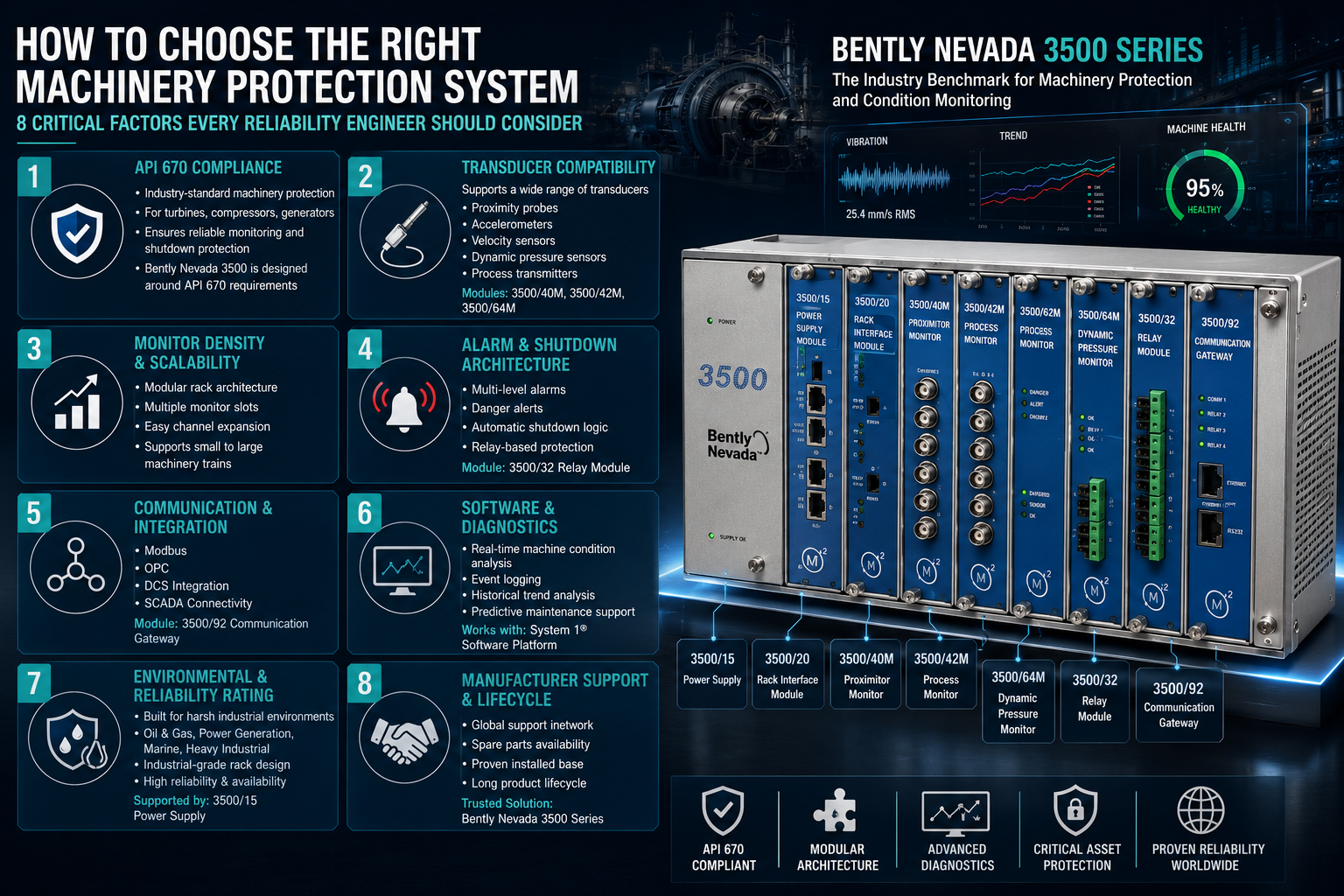
Condition Monitoring System Selection Infographic
Bently Nevada 3500 Series Complete Rack – In Stock
NEW Machinery Protection System | API 670 Compliant | 14 Monitor Slots | 7 Modules Pre-Installed
Order Your 3500 Rack Today30-Day Warranty • Free Shipping • API 670 Compliant